From DevSecOps to Agentic SecOps: Can AI Defend AI-Native Software?
Software is increasingly written, tested and operated with AI agents, and attackers are using agents too. Can security operations keep up by…
23 articles tagged Secure AI Engineering.

Software is increasingly written, tested and operated with AI agents, and attackers are using agents too. Can security operations keep up by…

When agents write code, open pull requests, change infrastructure and call tools, written policies and prompts are not enough. Rules have to…

In an agentic SDLC, AI agents take on work at every stage: specifying, coding, testing, reviewing, releasing and operating. This article des…

Organisations running many AI agents need more than per-agent controls. They need a security architecture: shared identity for agents, a gov…

Red teaming used to be something a security team did to a finished system. For AI agents, it has to start with the developers who build them…

MCP servers are now part of how software gets built: developers connect coding agents to repositories, ticketing, CI, cloud consoles and dat…

AI applications are built from models, datasets, notebooks, training pipelines, ML frameworks and serving infrastructure, each with its own…

With new agent SDKs from the major model providers, MCP support spreading and Google's Agent2Agent protocol just announced, building agents…

Most organisations now depend on a mix of AI model APIs, open-weight models, ML packages, datasets and hosted AI platforms. This year's inci…

NIST has published a draft profile of its Secure Software Development Framework for generative AI, and the EU AI Act received final approval…

An AI application is not just a model. It is a stack: users and identity, an application and gateway, prompts and context, retrieval, tools,…

AI red teaming started as something frontier model labs did before releases. With October's US Executive Order on AI and a year of LLM featu…

Retrieval-augmented generation has become the default way to connect LLMs to enterprise knowledge, and the most common way for AI features t…

LLM applications are moving into production faster than security practices are forming around them. This article sets out engineering princi…

Developers are building products on GPT-3, Codex and Stable Diffusion at a remarkable pace. These applications introduce security problems t…

Machine learning systems sit between data science, engineering, security and risk teams, and their security often belongs to none of them. W…

AI code assistants are spreading through development teams during Copilot's extended preview, often before security or legal teams have been…

2021 has been the year of software supply-chain attacks, from Codecov to hijacked npm packages last month. Machine learning teams face those…

MITRE's new ATLAS knowledge base catalogues real attacks on machine learning systems, and Microsoft has open-sourced Counterfit for testing…

MLOps brought CI/CD discipline to machine learning: versioned data, automated training pipelines and model registries. Security has mostly b…

Machine learning projects are built on a deep stack of open-source frameworks, Python packages, pre-trained models and public datasets, ofte…

Application security teams are increasingly asked to review systems with machine learning at their core. Some of their existing knowledge tr…
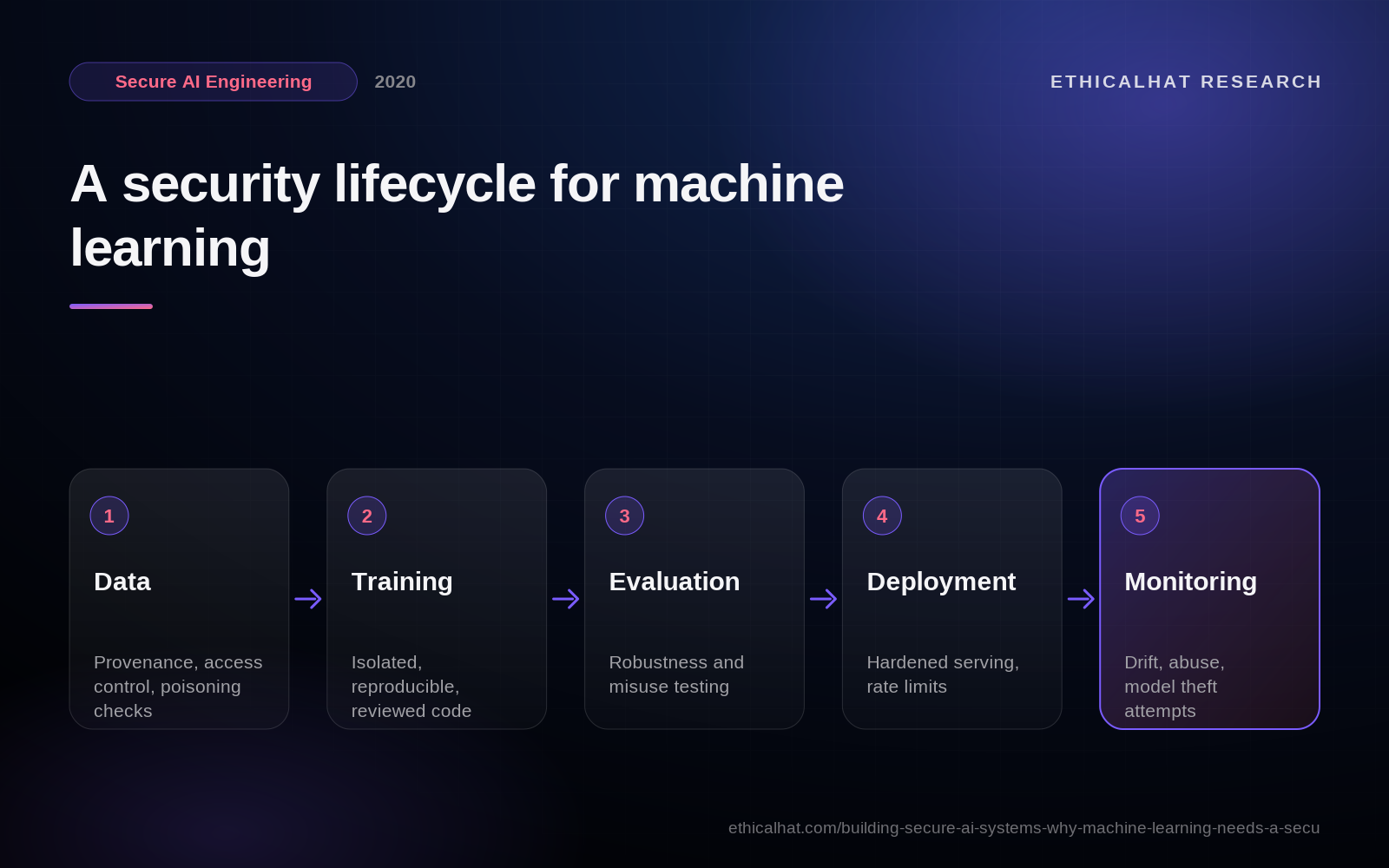
Machine learning is moving from research into products, but most ML projects have no security process at all. ML systems have the vulnerabil…