In many organisations, application security still works like this: development builds a release over weeks or months, then hands it to the security team for a penetration test shortly before launch. Findings arrive late, fixes are rushed or deferred, and security becomes the team that says "no" at the worst possible moment.
That model breaks completely when teams deploy many times a week. DevSecOps is the response: integrating security into every phase of the software development lifecycle (SDLC), so it becomes part of how software is built rather than a gate at the end.
More than a buzzword
DevSecOps has three ingredients:
- Culture and shared ownership. Security is everyone's responsibility. Developers own the security of their code, operations own the security of the platform, and the security team enables both with expertise, tools and guardrails.
- Automation. Repetitive checks run automatically in the pipeline, so they happen every time without slowing people down.
- Continuous feedback. Findings reach the people who can fix them quickly, in the tools they already use.
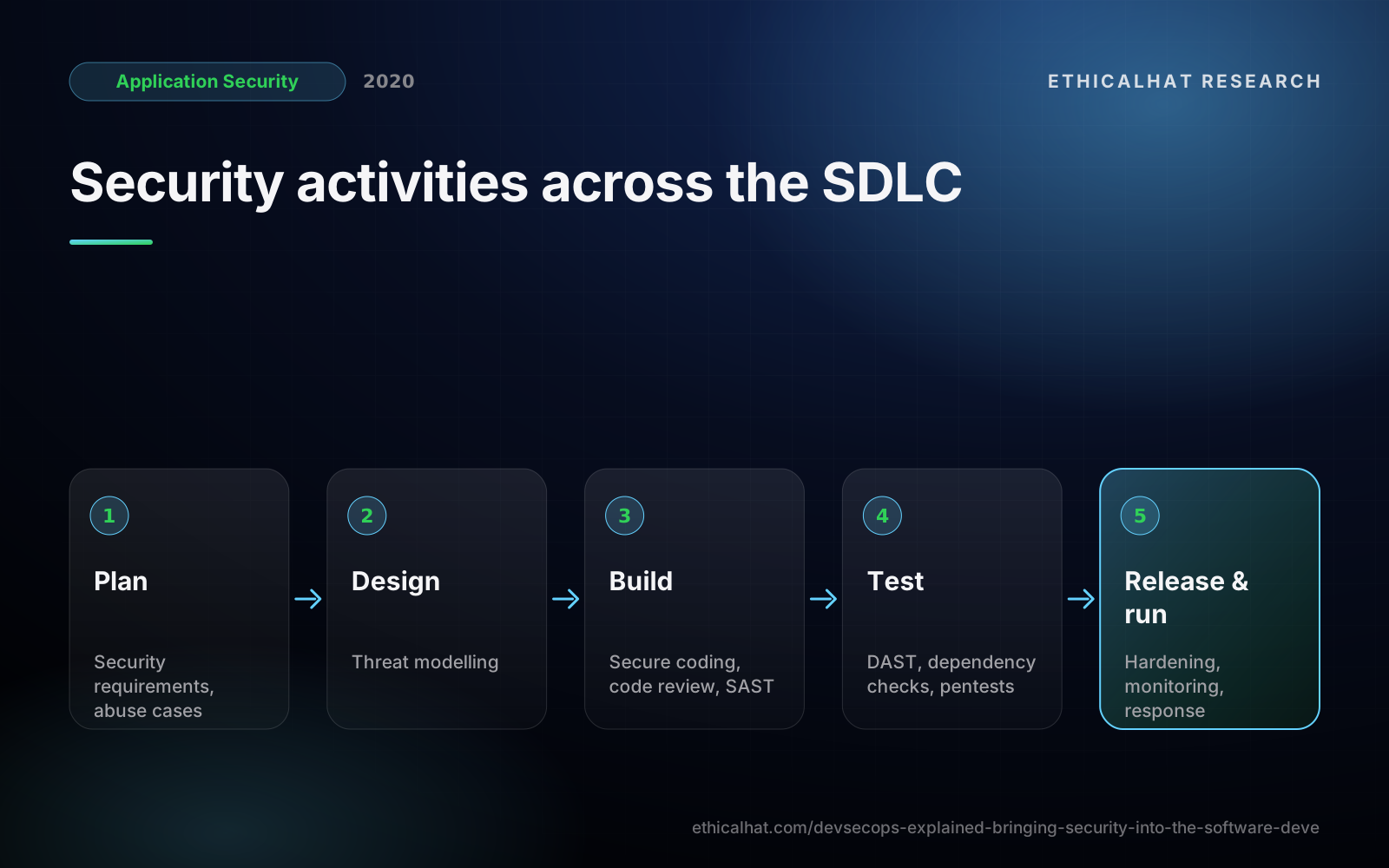
Security across the SDLC
flowchart LR
  P[Plan] --> D[Design] --> B[Build] --> T[Test] --> R[Release] --> O[Operate]
  O -->|incidents & findings| P
  P -.- P1[Security requirements<br/>abuse cases]
  D -.- D1[Threat modelling]
  B -.- B1[Secure coding<br/>code review, SAST]
  T -.- T1[DAST, dependency<br/>checks, pentests]
  R -.- R1[Config hardening<br/>secrets management]
  O -.- O1[Monitoring<br/>incident response]
Plan
Define security requirements alongside functional ones: authentication, authorisation, data protection, logging and compliance needs. Write abuse cases next to user stories: "As an attacker, I want to view other customers' orders by changing the order ID."
Design
Threat modelling is the highest-value security activity most teams skip. Before building, ask four questions (popularised by Adam Shostack):
- What are we building?
- What can go wrong?
- What are we going to do about it?
- Did we do a good job?
A lightweight session with a whiteboard and a framework such as STRIDE (spoofing, tampering, repudiation, information disclosure, denial of service, elevation of privilege) catches design flaws that no scanner will ever find.
Build
- Secure coding guidelines for your languages and frameworks, based on the OWASP Top 10.
- Peer code review that includes security questions.
- Static analysis (SAST) in the IDE and on every merge request.
- Safe-by-default libraries: parameterised queries, auto-escaping templates and vetted authentication components.
Test
- Software composition analysis to find known-vulnerable dependencies.
- Dynamic testing (DAST) against running applications in test environments.
- Security unit and integration tests for authorisation rules.
- Periodic manual penetration testing for high-risk applications and major changes.
Release
- Hardened configurations and infrastructure as code.
- Secrets in a vault, never in code or images.
- Signed, reproducible artefacts from a trusted pipeline.
Operate
- Security logging and monitoring, with alerts routed to a SOC.
- Vulnerability management for deployed components.
- Incident response plans that include application teams.
- Lessons from incidents fed back into requirements and design.
Where to start
Few organisations can adopt everything at once. A practical sequence:
- Dependency scanning and secrets scanning, which are fast, cheap and high-value.
- Threat modelling for new features in one or two teams.
- SAST in the pipeline, tuned to low false positives, reporting before blocking.
- Security champions: one developer per team with extra training and a direct line to the security team.
- Penetration testing targeted at the highest-risk applications.
Measuring maturity
Frameworks such as OWASP SAMM (Software Assurance Maturity Model) and BSIMM describe security practices across governance, design, implementation, verification and operations, with maturity levels for each. They help teams assess where they are and plan improvements incrementally, rather than trying to do everything at once.
Common pitfalls
- Tool-first thinking: buying scanners without changing ownership or processes.
- Too much noise: blocking builds on hundreds of low-confidence findings until developers ignore the tools.
- Security as a separate team's backlog: findings that never reach the people who can fix them.
- Skipping design: relying on testing to find flaws that should never have been built.
The bottom line
DevSecOps is not a product or a job title. It is the recognition that in continuous delivery, security must also be continuous, built into planning, design, code, tests and operations, and owned by the people doing the work. Start small, automate the basics, invest in threat modelling and champions, and improve step by step.
Our application security testing, secure code review and security training services help teams build DevSecOps practices that fit how they deliver software.


